 Blk 471B Yishun Street 42, #01-02, Singapore 762471
Restorations (Depending on material and size)

COMPOSITE RESIN RESTORATIONS (DIRECT INLAY/ONLAY/VENEER)
Dental veneers are custom made thin shells bonded to the tooth surface to enhance their colour, shape or size. Veneers can be one of the more conservative forms of dental restoration to address issues that are relatively minor and aesthetic in nature.
When Would I Need Dental Veneers?
As a procedure to enhance the appearance of your teeth, dental veneers are best suited for teeth that require minimal reconstruction of tooth structure. They are mostly used for aesthetic restorations of the following dental conditions:
- Chipped or broken teeth
- Discoloured or stained teeth that cannot be whitened
- Gaps between teeth
- Crooked or misshapen teeth
Benefits of Dental Veneers
While the benefits that dental veneers offer may differ depending on the type of material used, here are some advantages of veneers in general:
- Provide natural tooth appearance
- Less invasive compared to other forms of dental restoration as less extensive shaping is required
- Simple patient maintenance required
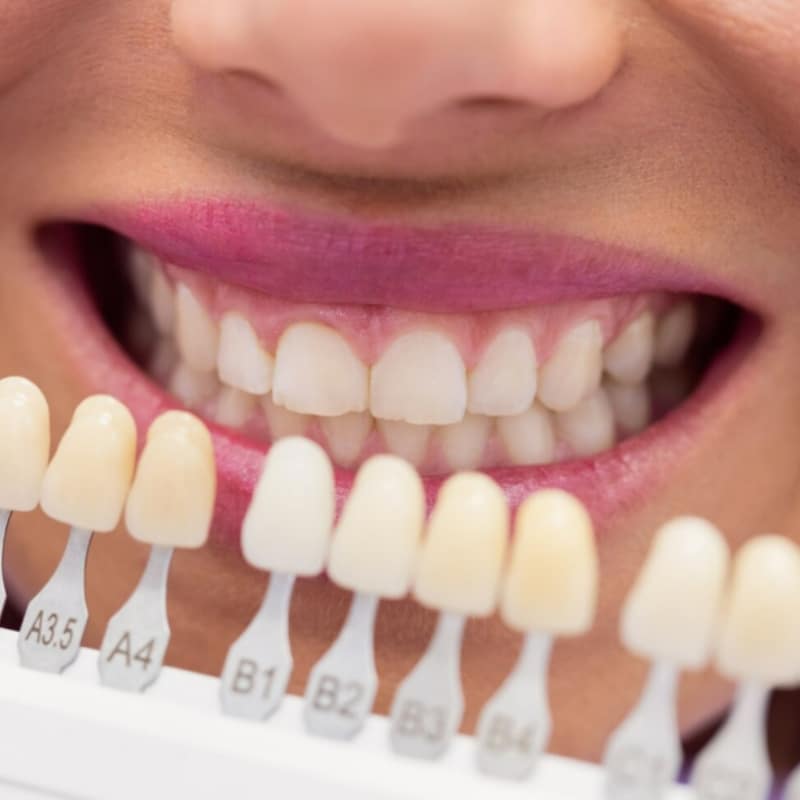

Types of Dental Veneers - Which is Better?
There are two main types of dental veneers to consider — composite veneers and porcelain veneers and the choice between them depends on factors such as procedure complexity, durability, and aesthetic results.
Composite veneers are created and applied directly to the teeth by the dentist in a single appointment. Since the shells are thinner than porcelain veneers, little to no tooth shaving is required, making the process more conservative. However, while composite veneers can produce great aesthetic results, they are more prone to chipping and staining, and typically last only a few years with proper oral care. The advantage is that they can be easily repaired if damaged.
On the other hand, porcelain veneers require at least two dental visits because they are custom-made in a dental laboratory. This procedure involves more tooth trimming to accommodate the veneer. Porcelain veneers are stronger and more durable than composite ones, lasting much longer when good oral hygiene is maintained. They also offer superior aesthetics, as their translucent properties reflect light like natural teeth and are more resistant to staining. However, unlike composite veneers, porcelain veneers cannot be repaired once chipped or broken they must be replaced entirely.
Procedure of Getting Dental Veneers
First Appointment
Similar to many other dental treatments, getting dental veneers begin with a preliminary consultant where X-Ray will be taken to investigate for signs of dental problems. The dentist will then trim about half a millimeter of the surface of your tooth enamel to prepare for the veneer. An impression or mould of your tooth may be taken to prepare for the veneer.
For porcelain veneer, the mould will be sent to the lab, and a temporary veneer may be used to protect your natural tooth before the next appointment. For composite veneer, the permanent veneer can be fixed onto your tooth on the same appointment.
Second Appointment
The temporary fittings will be replaced with the permanent veneer. The dentist will also check the fit and colour before the installation and trim if adjustments are needed, until the restoration fit is satisfactory before the veneer will be cemented to the surface of the tooth. A follow-up procedure may be scheduled.
While dental veneers are a simple procedure to restore the aesthetics of your teeth, they may not be suitable for all, especially if there is greater volume of the teeth to be replaced. In this case, crowns & bridges can be a better option to restore the entire tooth. A comprehensive examination with a dentist is necessary to determine your suitability.
Frequently Asked Question
Can I use both composite and porcelain veneers to meet my budget?
Yes, it is possible. However, we often do not recommend this.
Because they are two different materials, choosing the same shade of colour does not provide the exact match. Also, composite veneers are prone to staining as opposed to porcelain. Overtime, the difference would be even more visible.
Do veneers last forever?
Dental veneers go through wear and tear and will eventually need to be replaced. However, many patients are able to maintain their veneers well, depending on oral health condition and personal habits.
Why do I experience sensitivity in my tooth veneer-treated tooth?
Because enamel has been removed, the tooth of some individuals may become more sensitive to hot/cold food and beverages. Should you experience severe sensitivity, it could be caused by two reasons:
- Chipped veneer shell
- Decay of tooth under the veneer shell
Should you experience intense sensitivity, kindly make a dental appointment.
How should I care for my veneers?
Veneers can remain in good condition for a very long time with good oral habits. To prevent chips and dislodging (falling out) of veneers, refrain from the below habits:
- nail biting
- chewing on hard objects and food eg. ice, pencil, etc
- grinding of teeth
- clenching of teeth