 Blk 471B Yishun Street 42, #01-02, Singapore 762471
Root Canal Treatment

POSTERIOR TOOTH
Posterior Root Canal refers to a root canal treatment performed on the back teeth, specifically the premolars and molars. These teeth play a crucial role in chewing and grinding food, and they often have multiple roots and canals—sometimes three or more—making the procedure more complex than for anterior teeth.
Molars and premolars handle strong biting forces, a dental crown is often recommended after treatment to restore full strength and function. Without proper protection, a treated posterior tooth may be more prone to cracking or damage over time
Tooth Anatomy and Complexity
Posterior teeth, such as premolars and molars, often have multiple roots and canals—sometimes with curved or narrow pathways. This makes cleaning, shaping, and sealing the canals more challenging. The dentist must carefully assess the tooth’s internal anatomy using X-rays or digital imaging to ensure no canal is missed.
The dentist must have a precise understanding of the tooth’s internal anatomy to ensure that all canals are located, disinfected, and properly filled. Missed or untreated canals can lead to persistent infection or reinfection. Advanced imaging tools, such as digital X-rays or CBCT scans (cone-beam computed tomography), are often used to visualize the root structure and identify hidden or curved canals.
Additionally, the narrowness and curvature of posterior root canals require specialized instruments and careful technique to avoid complications such as instrument breakage or perforation.
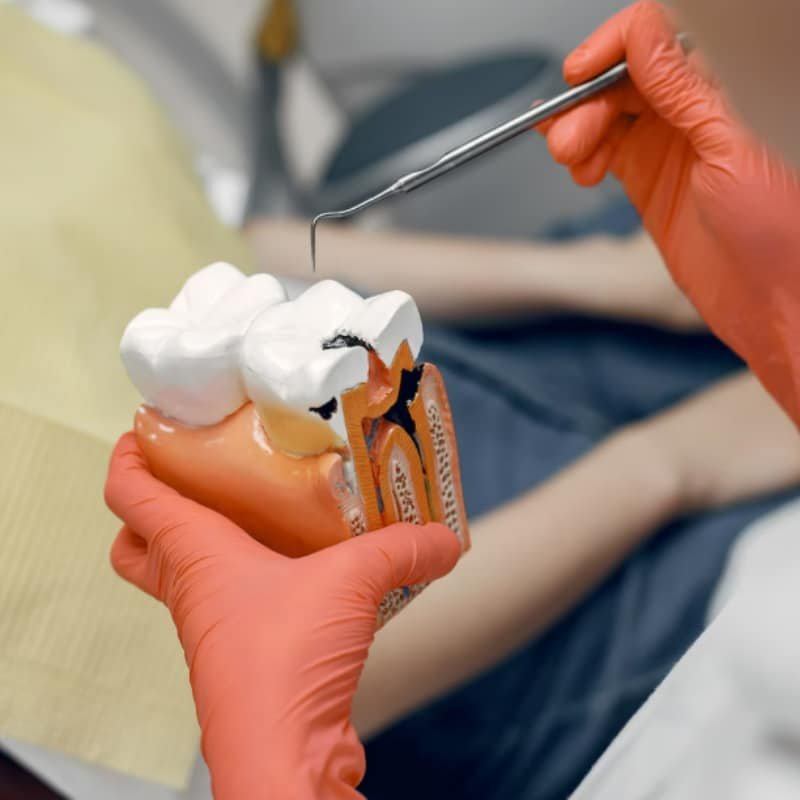

Strength and Structure of the Tooth
Strength and structure of the tooth are crucial factors to consider when performing a posterior root canal, as the back teeth (molars and premolars) endure the greatest biting and chewing forces. After the infected pulp is removed and the tooth is cleaned, its internal structure becomes weaker and more brittle, especially if a large portion of the natural tooth has already been damaged by decay or fracture.
Because of this, the dentist carefully evaluates how much healthy tooth structure remains before and after treatment. If the tooth is significantly weakened, additional reinforcement may be needed. This often includes placing a post inside the canal to strengthen the core and covering the tooth with a dental crown to restore its full function and prevent cracking.
Restoration and Long-Term Protection
Restoration and long-term protection are essential steps following a posterior root canal treatment to ensure the tooth remains strong, functional, and free from future infection. After the pulp is removed and the canals are sealed, the tooth becomes more brittle and prone to fracture, especially since posterior teeth handle the majority of chewing forces.
To restore the tooth’s strength and appearance, the dentist typically places a dental crown over it. The crown acts as a protective cover, preventing cracks, leakage, and bacterial reinfection. In some cases, if a large portion of the natural tooth is missing, a post and core build-up may be done before placing the crown to provide extra support and stability.
Proper restoration not only improves functionality but also ensures long-term durability, allowing the treated tooth to withstand daily biting and chewing. Patients are also advised to maintain good oral hygiene, attend regular dental check-ups, and avoid biting hard objects to extend the lifespan of the restoration.
Frequently Asked Question
What is a posterior root canal?
A posterior root canal is a dental procedure performed on the back teeth—the molars and premolars—to remove infected or damaged pulp tissue inside the tooth. It helps relieve pain, eliminate infection, and save the natural tooth from extraction while restoring proper chewing function.
Why is a crown needed after a posterior root canal?
After the root canal, the tooth becomes weaker and more brittle because the pulp has been removed. Since molars and premolars handle strong biting forces, a dental crown is usually placed to protect the tooth from cracking and to restore its full strength and function.
Is a posterior root canal painful?
No, the procedure is not painful. It is performed under local anaesthesia, ensuring the patient feels no pain during the process. After treatment, there may be slight soreness or tenderness, which can be easily managed with pain medication and usually subsides within a few days.
How long does a posterior root canal last?
With proper treatment, restoration, and good oral hygiene, a posterior root canal can last for 10 years or more—often a lifetime. Regular dental check-ups and avoiding habits like chewing hard foods or ice help prolong the lifespan of the treated tooth and its crown.