Blk 471B Yishun Street 42, #01-02, Singapore 762471
How long do braces take? For many patients, orthodontic treatment with fixed braces takes around 12 to 24 months, although the exact timeline depends on the complexity of the tooth and bite problems being treated. The American Association of Orthodontists (AAO) notes that some mild cases may take only several months, while complex cases involving significant tooth movement or jaw problems can take several years.
Braces work gradually because teeth need time to move through the surrounding bone. This means treatment cannot simply be rushed without considering the health of the teeth, gums, and supporting tissues.
How Long Do Braces Take on Average?
Most people can expect braces to remain in place for roughly 12 to 24 months, although some treatment plans may be shorter or longer. NHS orthodontic guidance gives an average treatment duration of 18 to 24 months, particularly for conventional orthodontic treatment.
The timeline is influenced by factors such as:
- How crowded or spaced the teeth are
- Whether the bite needs correction
- The position of individual teeth
- The patient’s age and dental development
- Whether teeth need to be extracted
- How consistently appointments are attended
- Whether elastics or other appliances are required
- Oral hygiene and the condition of the teeth and gums
A dentist or orthodontist can only provide a personalised estimate after examining the teeth and bite.
What Factors Affect How Long Braces Take?
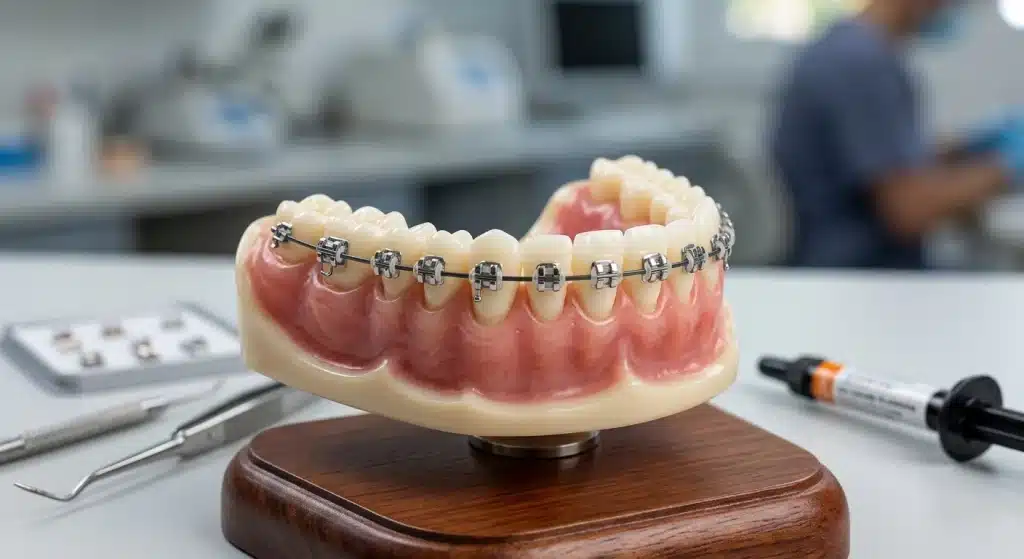
The Complexity of Your Teeth and Bite
The severity of the orthodontic problem is one of the biggest factors affecting treatment time. Mild crowding or spacing may be corrected relatively quickly, while significant crowding, deep bites, underbites, or complex tooth movements can require considerably longer treatment.
The AAO reports that mild cases may sometimes take around 8 to 12 months, while more complex orthodontic problems can take a couple of years or longer.
Before starting orthodontic treatment, it is important to make sure your teeth and gums are healthy enough for braces. A dental check-up can help identify issues such as tooth decay, gum problems, or other concerns that may need to be addressed before treatment begins.
Your Age and Tooth Development
Braces can work at different ages, but the treatment plan depends on the patient’s dental development. Adults can still have successful orthodontic treatment, although some cases may take longer because adult teeth are more firmly established in the jaw.
This does not mean that adults cannot achieve effective results. Instead, the orthodontist needs to account for factors such as existing fillings, missing teeth, gum health, and previous dental treatment.
Your Treatment Compliance
Following your orthodontist’s instructions can help keep treatment progressing as planned. Missed appointments, broken brackets, or failure to wear prescribed elastics can interrupt the planned movement of the teeth.
The AAO recommends keeping scheduled appointments, following instructions about elastics, maintaining good oral hygiene, and avoiding foods that can damage braces.
What Is the Typical Braces Treatment Timeline?
Although every treatment plan is different, orthodontic treatment generally follows several stages.
- Initial consultation and assessment
Your dentist or orthodontist examines your teeth and bite. Photographs, dental X-rays, measurements, or other diagnostic records may be used to develop a treatment plan.
- Treatment preparation
Existing dental problems such as cavities or gum disease may need to be addressed before braces are fitted. The AAO specifically recommends establishing good oral health before orthodontic treatment begins.
- Braces placement
Brackets are attached to the teeth and connected with orthodontic wires. The braces then apply controlled forces to gradually move the teeth.
- Regular adjustments
Your orthodontist monitors tooth movement and adjusts the braces throughout treatment. The AAO says appointments are commonly scheduled every 6 to 10 weeks, although the interval depends on the individual treatment plan.
- Braces removal
Once the teeth and bite have reached the planned positions, the braces are removed and the teeth are cleaned.
- Retention
Retainers are used after active orthodontic treatment to help maintain the new positions of the teeth. Teeth can naturally shift over time, so retention is an important part of maintaining the result.
How Long Do Different Braces Take?
The type of orthodontic appliance does not automatically determine how fast treatment will finish. The complexity of the case and the movements required are usually more important.
| Treatment option | Typical timeline | What affects the duration? |
|---|---|---|
| Traditional metal braces | Around 12–24 months for many cases | Crowding, bite, tooth movement |
| Ceramic braces | Often similar to fixed braces | Complexity and treatment response |
| Self-ligating braces | Varies by case | Tooth movement and treatment plan |
| Lingual braces | Varies by case | Complexity and appliance suitability |
| Clear aligners | Varies significantly | Number of aligners and compliance |
These ranges should not be treated as guarantees. Two patients using the same type of braces can have very different treatment times because their orthodontic problems are different.
Can You Make Braces Work Faster?
There is no reliable way to safely force teeth to move dramatically faster than the biological process allows. However, good treatment habits can help prevent unnecessary delays.
To keep your treatment on schedule:
- Attend orthodontic appointments as planned.
- Wear elastics exactly as instructed.
- Brush and floss carefully around brackets and wires.
- Avoid hard, sticky, or crunchy foods that could damage your braces.
- Report broken brackets or wires rather than waiting for the next appointment.
- Continue regular dental check-ups during orthodontic treatment.
Keeping your mouth healthy is particularly important because cavities, gum inflammation, or other dental problems may interfere with orthodontic treatment.
What If You Have Tooth Pain Before Getting Braces?
Orthodontic treatment usually starts after your dentist confirms that your teeth and gums are healthy enough for braces. If you have persistent tooth pain, sensitivity, swelling, or another dental problem, it may need to be assessed before orthodontic treatment begins.
For patients experiencing tooth pain around Yishun, toothache treatment in Yishun can help identify the underlying cause before orthodontic treatment is planned.
This is important because toothache is not simply an orthodontic issue. It may be related to decay, an infection, a damaged filling, gum disease, or another dental condition that requires separate treatment.
A Simple Example: Why Two Patients May Need Different Treatment Times
Consider two patients who both want straighter front teeth.
The first patient has mild spacing between several front teeth but has an otherwise healthy bite. Their treatment may be relatively straightforward and could take considerably less time than a standard comprehensive case.
The second patient has significant crowding combined with a bite problem. Their treatment may require more tooth movement, elastics, or additional orthodontic planning, resulting in a longer timeline.
This is why asking only “how long do braces take?” cannot produce one exact answer. The treatment duration needs to be based on the individual’s dental condition.
Why Do Braces Sometimes Take Longer Than Expected?
Treatment can extend beyond the original estimate for several reasons. Teeth do not always respond at exactly the same rate, and unexpected dental issues can also affect progress.
Common reasons include:
- Missed or delayed orthodontic appointments
- Broken brackets or wires
- Poor compliance with elastics
- Inadequate oral hygiene
- More complicated tooth movement than initially expected
- Changes to the treatment plan
- Slower-than-expected biological tooth movement
An estimated treatment duration is therefore a planning guide rather than a fixed deadline.
Conclusion: How Can You Find Out How Long Your Braces Will Take?

So, how long do braces take? For many patients, treatment falls within the 12–24 month range, but the actual timeline depends on the severity of the orthodontic problem, the required tooth movements, oral health, age, treatment compliance, and individual response to treatment.
At Ivory Dental, orthodontic treatment is planned around the patient’s dental condition rather than applying one fixed timeline to everyone. A proper assessment can help determine the type of orthodontic treatment required and provide a more realistic estimate of how long your braces may take.
If you are considering braces or want to understand whether orthodontic treatment is suitable for your teeth, visit Ivory Dental to learn more and arrange a consultation.
If you are considering braces and want a clearer estimate of how long your treatment may take, a professional assessment can help determine the right approach for your teeth and bite. Contact Ivory Dental to arrange a consultation and discuss your orthodontic treatment options.
FAQ (Frequently Asked Questions)
How long do braces take to straighten teeth?
Many patients wear braces for approximately 12 to 24 months, while NHS guidance commonly cites an average of 18 to 24 months for orthodontic treatment. Mild cases can be shorter, while complex cases may take several years.
Can braces take only 6 months?
Some limited orthodontic corrections may be completed in several months, particularly when only minor tooth movements are required. However, a short treatment time is not suitable for every patient, especially when the bite or multiple areas of the mouth need correction.
Do braces take longer for adults?
They can in some cases. Adult teeth are more firmly established in the jaw, and adults may also have fillings, missing teeth, gum conditions, or other dental factors that influence treatment planning. However, age alone does not determine the final treatment duration.
How often do I need orthodontic appointments?
Orthodontic adjustment appointments are commonly scheduled every 6 to 10 weeks, although your exact schedule depends on your treatment plan and how your teeth are progressing.
Do I still need a retainer after braces?
Yes. Retainers help keep teeth in their corrected positions after braces are removed. Teeth can naturally shift throughout life, so your orthodontist will advise you on how and when to wear your retainer.